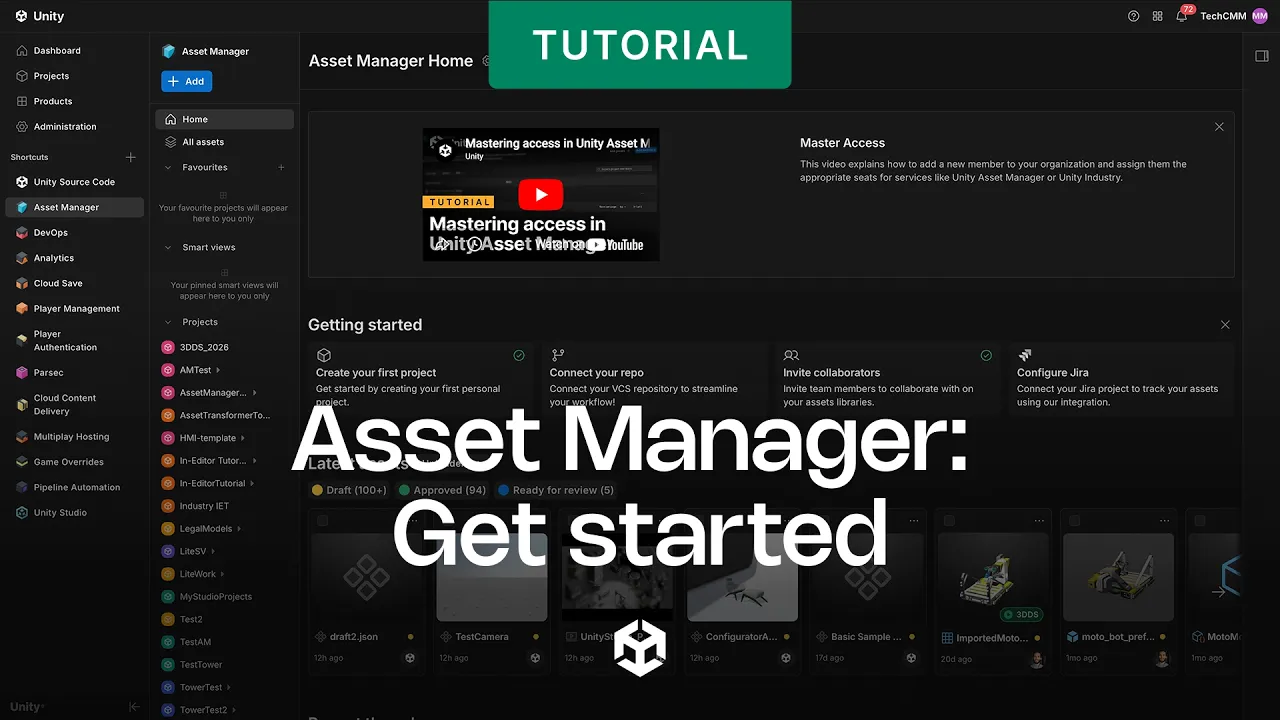
Helping Teams Manage Assets at Scale
Designing asset management tools across Unity's web platform and editor, helping creators in gaming and beyond organize their work and collaborate seamlessly with their teams.
Designing Asset Management for the Unity Ecosystem
I'm the designer behind Asset Manager, Unity's professional Digital Asset Management (DAM) product. My role is to make a powerful, complex tool feel clearer and more capable, whether the user is a game studio coordinating thousands of files or an industrial team managing 3D content across a pipeline.
I work closely with product managers, engineers and designers to evolve Asset Manager across the broader Unity ecosystem. Every decision sits at the intersection of real user needs and business opportunity, grounded in continuous user feedback rather than assumptions.
I ground my proposals in three things: the deep expertise of my colleagues, my own perspective as someone using Unity daily for the first time, and years of user interviews, which I now pair with AI to surface the most relevant entry points.
Recent work spans:
more granular asset sharing (improved RBAC, folder sharing, and libraries)
clearer ways to surface file references and dependencies in the inspector and graph nodes
reducing UI complexity without sacrificing capability
Improving My Workflow with AI
I joined Unity at a moment when AI opened up real opportunities to rethink how we work. I'm eager to test new tools early, and I put that to use straight away: from my first week, I started experimenting with Figma's MCP and Claude Code to build high-fidelity local prototypes and explore a new design workflow.
I had the chance to present this AI-powered workflow to the design team at a company offsite, helping the practice take hold beyond my own work.
Today, alongside my product work, I collaborate closely with the design system team on AI-and-design topics, and actively improve our Figma library and Claude Skills to make prototype creation faster and easier.
Because these prototypes run on a tech stack close to our product, they hold up better in stakeholder presentations, surface issues I'd normally only catch in QA, get user feedback earlier, and make engineering handoff far smoother.
Prototyping is only one part of it, I experiment with AI across most of my recurring workflows. I automated a weekly recap for my manager and teammates using Claude Cowork, pulling from Jira, Slack, and meeting recordings to summarize where everything stands. It means less meeting time spent walking through small updates, and more room for in-depth discussion and design crits.
Conclusion
" transform="translate(3 2)" width="208px"/></g></svg>)